

The Candour Foundation

The Candour Foundation is the world’s first research and implementation alliance for candour and accountability in public life.
Based within the Centre for People’s Justice at the University of Liverpool, it is a major programme of research, training and partnership working to support implementation of the new Hillsborough Law duty of candour set out in the Public Office (Accountability) Bill.
The Foundation applies the Centre’s distinctive social justice research methodology to one of the most important challenges facing public institutions: how to support the culture change needed to strengthen public trust and confidence in public decision-making, institutional honesty and accountability.
At the heart of the Foundation is a powerful alliance between academics, practitioners and people with first-hand knowledge through lived experience of institutional cover-up, deception and the struggle for truth and accountability. Rather than treating lived experience as something to be studied from a distance, the Foundation brings people together as partners in the creation of knowledge. Through trauma-responsive and creative research, the aim is to ensure that first-hand knowledge helps shape how candour is understood, defined, implemented and taught across public life.
The breadth of knowledge within this alliance is extraordinary. It includes direct experience of Hillsborough, Grenfell, the Post Office Horizon scandal, Infected Blood, forced adoption and mother-and-baby institutions, Manchester Arena, Covid-19 bereavement, Sodium Valproate, nuclear test veterans and their descendants, and the campaign for truth about Zane Gbangbola. Combined with practitioner expertise, legal analysis, public inquiries, inquests, documentary evidence and academic research, this has created an unprecedented knowledge base about candour and non-candour in public life.
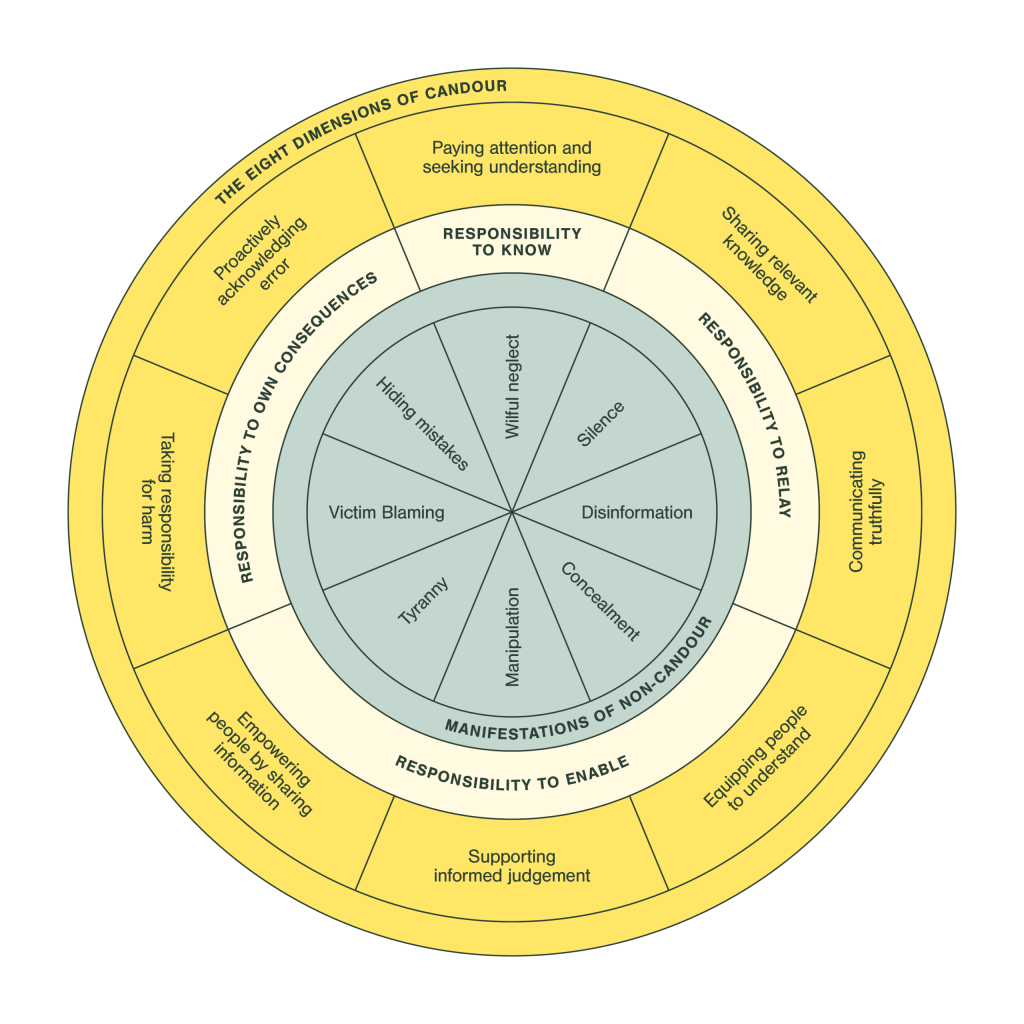
The result is the Eight Dimensions of Candour, an evidence-based model which identifies candour and non-candour as observable practices and behaviours. It translates the legal duty into the everyday practices of public service and provides a foundation for implementation, organisational learning and culture change.
Candour is often discussed as a value, a professional virtue or a legal obligation. Our research takes a different approach. It shows that candour and non-candour are expressed through observable practices, behaviours, decisions and organisational conditions. The Eight Dimensions therefore provide a practical framework for understanding what the new duty requires in everyday professional life, and what public institutions must do if candour is to become part of organisational culture rather than simply a legal requirement.
This matters because Hillsborough Law creates significant new responsibilities for public authorities and public officials. Legislation can establish duties, expectations and consequences. It cannot, by itself, determine how a new legal concept will be understood inside institutions or how it will be translated into everyday decisions, professional relationships and organisational practices.
The Candour Foundation exists to help meet the challenge of implementation. It brings together research, first-hand knowledge and professional expertise to develop the evidence, resources and capability needed to support implementation of the duty of candour across public life.
We are particularly proud to have partnered with Liverpool and Nottingham City Councils in the development of this work. The partnership has profound significance. Liverpool and Nottingham were connected by the Hillsborough disaster, the years of institutional non-candour that followed, and the long struggle for truth and accountability. Today, those same cities are helping to lead the development of an evidence-based approach to implementing one of the most significant public-service reforms in a generation.
Professional knowledge is a vital part of that process. Through collaborative inquiry with staff from Liverpool and Nottingham, the Foundation has brought practitioner experience into direct dialogue with lived-experience and academic knowledge. This has helped shape the training model, implementation approach and evaluation framework.
The Foundation’s training programme reflects the same philosophy. It is not conventional compliance training and it is not simply a legal update. Powerful films created by lived-experience contributors sit at the heart of the programme, bringing first-hand knowledge into direct conversation with professional practice. Combined with the Eight Dimensions, facilitated reflection and practical activities, the training creates space for public servants to think seriously about what candour requires in their own work, teams and organisations.
The ambition is substantial. The Candour Foundation is building a centre of authority for research, implementation and professional learning on candour in public life. By bringing lived-experience, practitioner and academic knowledge together, it seeks to ensure that the promise of Hillsborough Law does not end with legislation, but becomes part of everyday public service across the United Kingdom.