Temporary Accommodation: A Priority for Social Justice Research


How long is ‘temporary’? For some families and single people, temporary accommodation can mean years of uncertainty.
There is no legal limit on how long a council can keep someone in temporary accommodation, as long as the council is taking ‘reasonable’ steps to find an alternative, more settled home. The shortage of housing means it is not easy for councils to find longer-term solutions. So what can a resident do if their temporary accommodation is overcrowded, mouldy, infested with mice or damaging to their health? Although accommodation is supposed to be in good repair and not hazardous to health, getting problems put right can be extremely difficult if neither the landlord nor the council listens to residents’ concerns.
The Centre for People’s Justice has identified the temporary accommodation crisis as a priority for social justice research. A secure home affects much more than where you sleep. It can shape your health, your ability to work and your children’s chances at school. Thousands of families have nowhere suitable to cook or wash school uniforms. Some live in cramped conditions or even have to share beds.
The financial cost is already enormous. A Big Issue investigation found that in the last year, councils spent £2.93 billion on temporary accommodation, with around two-thirds going to private providers for some of the least suitable forms of housing, including hostels and bed and breakfasts.
But £2.93 billion does not capture the full cost. Harm caused by unsuitable and insecure temporary accommodation can be life-changing and intergenerational, with costs that mount up over decades: the effects of damp, mould or overcrowding on health; the anxiety of not knowing when you will have a permanent home and being repeatedly uprooted; and the difficulty of studying, working or raising a family without somewhere safe and secure to live.
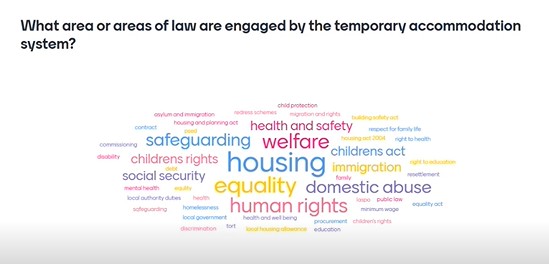
The law is intended to protect people who are homeless and ensure that temporary accommodation is suitable. Landlords, councils and other public bodies are subject to housing, equality, human rights and public law duties intended to prevent homelessness and ensure temporary accommodation is safe and suitable. Yet people continue to experience overcrowding, displacement, insecurity, poor conditions and long periods in limbo. Understanding why these legal protections do not always work in practice, and how they could work better, could dramatically improve people’s lives. This is why the Centre for People’s Justice has identified temporary accommodation as a priority for social justice research.