
The rapid exchange of ideas around Temporary Accommodation demonstrated the power of collective inquiry. Bringing together diverse perspectives uncovered new insights and revealed the often unseen connections linking sectors, disciplines, and social justice challenges.
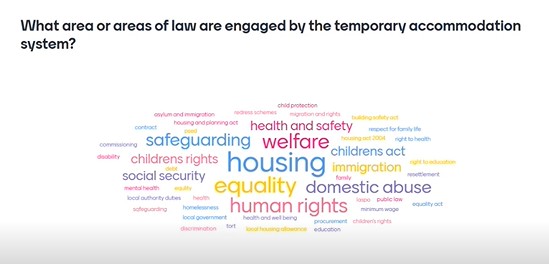
If asked, how many areas of law would you think are engaged by the system of temporary accommodation in the U.K.? Three? Five? How about thirty? This was one of the questions posed to those attending the first Where Research Gets Real event hosted by the Centre for People’s Justice recently, and the group-sourced answer that resulted.
Legal areas as broad as public law and contract, and as diverse as health and safety, children’s rights, and procurement, were highlighted, showcasing how everyone in the session, although attending due to a professional or personal interest in temporary accommodation, came with very different expertise, experience, and perspectives on how the law can be made to work harder to improve the lives of those impacted. In this way, research becomes part of the process of change, as the sharing of knowledge between participants allows for the collaborative distillation of alternative legal approaches where they might otherwise have remained siloed and disparate.