housing word art

Research Insights

The Centre for People’s Justice brings together people with very different kinds of knowledge and experience to tackle social justice problems that can feel impossible to shift. When those perspectives meet, research becomes a space for seeing the problem differently and finding space for change. 

Where Research Gets Real – Temporary Accommodation

Article written by Dr Danielle Gallagher

Published 20 October 2026

The rapid exchange of ideas around Temporary Accommodation demonstrated the power of collective inquiry. Bringing together diverse perspectives uncovered new insights and revealed the often unseen connections linking sectors, disciplines, and social justice challenges.

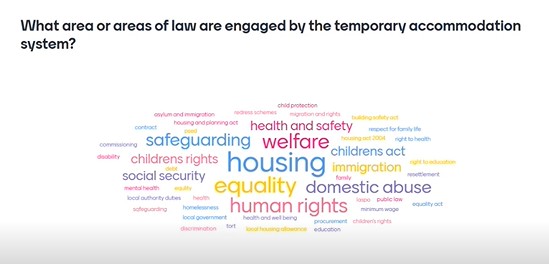
If asked, how many areas of law would you think are engaged by the system of temporary accommodation in the U.K.? Three? Five? How about thirty? This was one of the questions posed to those attending the first Where Research Gets Real event hosted by the Centre for People’s Justice recently, and the group-sourced answer that resulted.


Legal areas as broad as public law and contract, and as diverse as health and safety, children’s rights, and procurement, were highlighted, showcasing how everyone in the session, although attending due to a professional or personal interest in temporary accommodation, came with very different expertise, experience, and perspectives on how the law can be made to work harder to improve the lives of those impacted. In this way, research becomes part of the process of change, as the sharing of knowledge between participants allows for the collaborative distillation of alternative legal approaches where they might otherwise have remained siloed and disparate.

Existing laws are being passively ignored or actively violated

The format of a Where Research Gets Real session allows for focused input on a given topic – in this case Temporary Accommodation – by a carefully selected variety of practitioners working in that area, along with prompts for discussion both in Q&A format and breakout groups by all present. The curation of input from people for whom this is a priority issue allows for a diverse ‘setting the scene’, where the speakers’ presentations interlink, complement and broaden the scope for conversation and sharing around the legal issues highlighted.

This event included presentations from Liam Geraghty, a Big Issue Deputy Editor with a focus on insecure housing, Sue James of the Legal Action Group – a former housing solicitor with over 10,000 cases’ experience, and Maia Kirby of Good Jobs First, an organization that has, amongst other advocacy and resource outputs, created Violation Tracker, a database where anyone can search corporate misconduct, including by private housing suppliers. Also presenting, and facilitating the discussion points, were Catriona Cannon (Glasgow University) and Gillian Kane (Ulster University), along with Leeanne O’Hara (Homeless Connect), speaking about the research project they have been developing on public sector provision of temporary accommodation, and how public sector equality duties might be one way of improving the system and lessening the existing accountability gaps. However, the presenters are only half the story in Where Research Gets Real. The other attendees – working in organisations like Citizens UK and the Social Brokers, in the legal profession, and in many strands of justice-oriented academia, all came with such a diversity of approach and experience that the topic was broken open and re-shaped in discussion in ways that one singular approach could never hope to replicate.

160,000 households in the UK temporary accommodation; 180,000 children in England alone; an increase of 80,000 people in temporary accommodation in 5 years … as participants noted, showing the scale of the issue and engendering outrage about it are key to ensuring wider engagement and impact.
(Official statistics, Ministry of Housing, Communities and Local Government, 2026) 

Sue’s incisive portrayal of how the decimation of legal aid, and legal protections, courtesy of the Legal Aid, Sentencing and Punishment of Offenders Act 2012 has worked alongside the housing crisis, the cost-of-living crisis, and the huge shortage of legal aid lawyers to create a ‘perfect storm’ was particularly striking. This fed especially well into asking those present to identify the area or areas of law that regulate or impact on the system of temporary accommodation. Meanwhile, Maia’s examples of corporate greed from the Violation Tracker brought home the realities of the overview shared by Liam, as well as the lack of enforcement resulting in cases of horrific dereliction of responsibility. The importance of research that helps people realise their rights and make the connection between their lived experience and the law, as well as empowering them with the knowledge to challenge failures was one of a number of common threads throughout the session. In the face of those horrendous living conditions, it was exciting to then hear how Catriona, Gillian and Leeanne’s research will look at the transformative potential of meaningful and creative engagement with these lived experiences, as well as seeing how the regulatory processes play out differently depending on immigration status.

Along with the myriad legal and social justice advocacy specialisms brought by those present comes the wide array of geographical experience. This is not just relevant to thinking about housing approaches within the devolved governments. Even considering England alone, it was clear that different council areas facing the same or similar problems such as a lack of housing stock have very different procurement approaches which then impact heavily on temporary accommodation tenants. Furthermore, creative and diverse methods for working and researching with vulnerably housed participants were also highlighted by presenters and participants, showing the great potential for sharing and learning good methodological practice as well.


The importance of research that helps people realise their rights and make the connection between their lived experience and the law, as well as empowering them with the knowledge to challenge failures was one of a number of common threads throughout the session.

160,000 households in temporary accommodation; 180,000 children in England alone; an increase of 80,000 people in temporary accommodation in 5 years. £10,000 per calendar month paid by a council to a private asset management company that wouldn’t even let the temporarily housed tenants in its high-rise flats use the built-in aircon during the heatwaves of 2026. These were some of the facts shared by presenters. They are shocking, but as participants noted, showing the scale of the issue and engendering outrage about it are key to ensuring wider engagement and impact. That can then lead to evidence-based improvements, enforcement of existing laws currently being passively ignored or actively violated, private and public sector accountability, and better practice all round.

Sue remarked that in LAG’s experience, people are more likely to talk to their GP about the impacts of temporary housing than they are to a lawyer, and the issue at the heart of that comment – of not connecting temporary accommodation experience to one’s legal rights, speaks to one of questions that remains under discussion following the session: how can we talk about public sector equality duties in a way that people impacted by temporary accommodation might connect with?