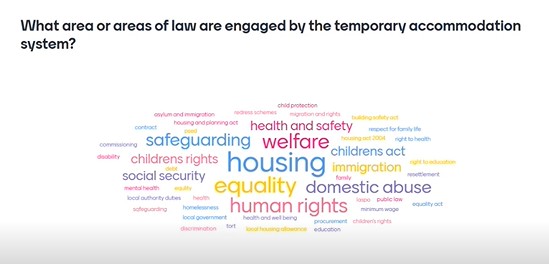
Housing is a key social justice issue for many communities, including women and children escaping domestic abuse, those with precarious immigration status, children in the care system, families on low incomes, workers in low-paid jobs, people with mental or physical disabilities, and prison leavers. Too often, people do not know their rights or are not able to get action taken by the bodies responsible for upholding those rights. This is particularly problematic because living in temporary accommodation can mean living in precarious circumstances that make navigating complex administrative systems almost impossible.
The Centre for People’s Justice organises and supports four Community Steering Groups, creating ongoing opportunities for researchers to listen to and engage in detailed conversations with members of the public about the issues affecting their lives and communities. Established in partnership with the Bakers, Food and Allied Workers’ Union; Investing in Children; Women’s Support Network Northern Ireland; and Feeding Britain, these groups play a central role in helping the Centre identify and prioritise social justice issues. They provide a forum through which social injustice can be understood through the eyes of the public, helping researchers gain insight about not only what problems people face, but why particular issues demand urgent attention. Through these conversations, temporary accommodation has emerged as a priority concern because people affected often feel stranded, powerless and unable to improve their housing situations.
Through the Centre’s wider network of partner organisations, researchers have also consulted charities and free legal advice providers to understand where and why legal protections are failing in practice. A recurring theme is that laws intended to regulate landlords, accommodation providers and other actors within the temporary accommodation sector are not always being effectively enforced. Prosecuting landlords can be costly, while alternative enforcement mechanisms such as Civil Penalty Notices have been applied inconsistently. In a housing market where councils face intense pressure to secure growing volumes of temporary accommodation at the lowest possible cost, the rights of people living in that accommodation can become obscured, overlooked or unenforced.
Agencies exist to oversee local authority duties and ensure that temporary accommodation is suitable. Yet these bodies themselves recognise that councils are often unable to fulfil those duties because of wider pressures within the housing system.
The reasons why record numbers of people are trapped in poor-quality accommodation is therefore not simply a shortage of housing. It is also a failure of existing legal protections to deliver the outcomes they were designed to achieve.
The UK already has extensive housing regulations, equality and human rights protections. Local authorities have duties to provide suitable accommodation, while accommodation providers are required to meet legal standards. Yet much of the temporary accommodation sector is now delivered through complex arrangements involving private landlords and private companies, creating a significant gap between legal duties and everyday realities. Responsibilities are often dispersed across multiple organisations, making oversight, enforcement and accountability more difficult.
For the Centre for People’s Justice, this raises an important social justice research question. The key issue is not whether legal protections exist, but why they are not operating to their fullest effect. If people have rights to safe and suitable accommodation, what prevents those rights from being realised in practice? Where does accountability break down? Which organisations possess the legal powers to act, and what prevents those powers from being used effectively?
Addressing these questions requires more than legal analysis alone. Social justice research should involve people with direct experience of temporary accommodation and of trying to secure accountability when legal protections fail. Their knowledge can help identify where existing laws and regulatory mechanisms are breaking down, how rights can be exercised more effectively, and what practical barriers prevent people from obtaining the protections to which they are entitled. Research can also generate case studies showing how a social justice approach can strengthen public understanding of the law and support its effective use in everyday life.
This matters because housing is far more than a question of shelter. Secure housing provides the foundation upon which family life, education, employment, health and participation in community life depend. When legal protections intended to safeguard housing fail in practice, the consequences extend well beyond accommodation itself, affecting people’s ability to build stable, secure and flourishing lives.
Research should identify points of accountability failure and explore ways to improve enforcement, support collective action and enable existing legal powers to achieve the outcomes they were intended to deliver. Understanding how rights become disconnected from remedies, and how legal responsibilities become diffused across complex institutional arrangements, is essential if existing protections are to achieve their full potential.